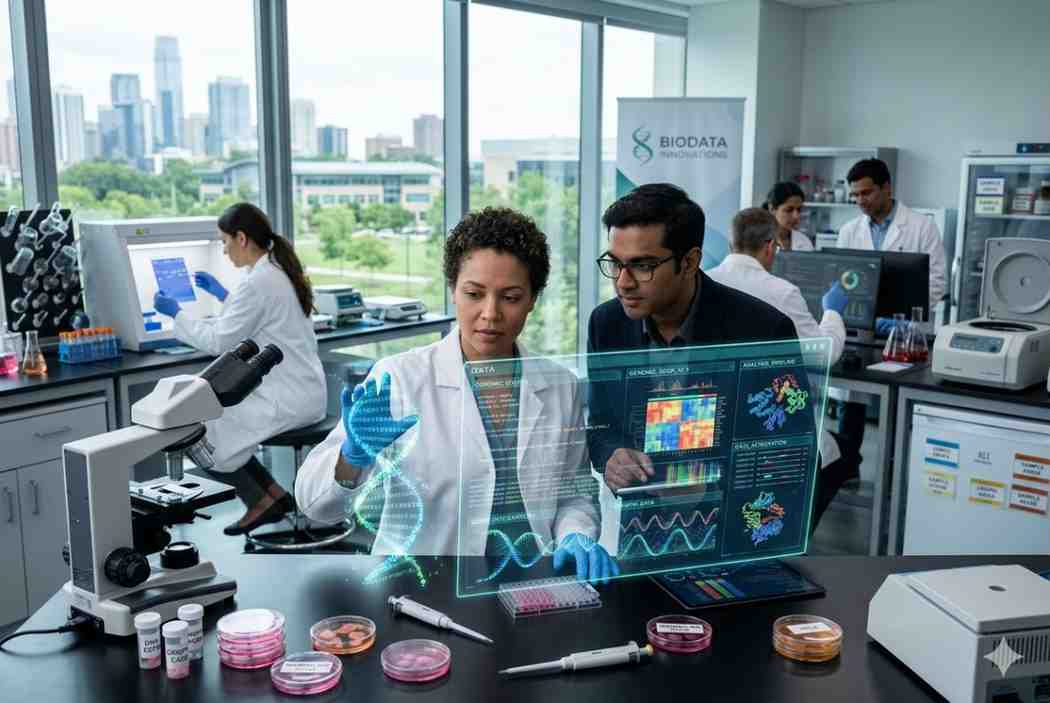
Bioinformatics: Where Biology Meets Data Science
Lisa Park • October 8, 2026
In the age of big data and rapid scientific discovery, few fields are as transformative as bioinformatics. Sitting at the intersection of biology, computer science, and statistics, bioinformatics has revolutionized how we understand life at the molecular level. From decoding genomes to designing personalized medicine, this dynamic discipline is shaping the future of healthcare, agriculture, and biotechnology.
What is Bioinformatics?
Bioinformatics is the science of collecting, analyzing, and interpreting biological data using computational tools and techniques. It focuses on making sense of complex datasets such as DNA sequences, protein structures, and gene expression patterns.
At its core, bioinformatics answers fundamental questions:
- What does our genetic code reveal about us?
- How do genes influence diseases?
- Can we predict biological behavior using data?
By combining biology with algorithms and software, bioinformatics transforms raw data into meaningful insights.
The Origins of Bioinformatics
The roots of bioinformatics can be traced back to the late 20th century, when advances in molecular biology and computing began to converge. A major milestone was the Human Genome Project, an international effort to map the entire human genome.
This groundbreaking project generated enormous amounts of data, making it clear that traditional methods were insufficient. Scientists needed computational approaches to store, process, and analyze genetic information—thus giving rise to modern bioinformatics.
Key Areas of Bioinformatics
Bioinformatics is a broad field with several specialized areas:
1. Genomics
Genomics involves the study of entire genomes—the complete set of DNA in an organism. Bioinformatics tools help sequence, assemble, and analyze genomes, enabling researchers to identify genes and understand their functions.
2. Proteomics
Proteomics focuses on the study of proteins, which are essential for cellular function. Bioinformatics helps predict protein structures, interactions, and functions based on sequence data.
3. Transcriptomics
This area examines RNA transcripts produced by genes. By analyzing gene expression patterns, scientists can understand how cells respond to different conditions.
4. Structural Bioinformatics
This involves modeling the three-dimensional structures of biological molecules. Understanding these structures is crucial for drug design and molecular biology research.
5. Computational Biology
Often used interchangeably with bioinformatics, computational biology emphasizes the development of mathematical models and simulations to study biological systems.
Tools and Technologies
Bioinformatics relies on a wide range of tools and technologies:
- Databases: Store vast amounts of biological data (e.g., GenBank, Protein Data Bank)
- Algorithms: Used for sequence alignment, gene prediction, and pattern recognition
- Programming Languages: Python, R, and Java are commonly used
- Machine Learning: Helps identify patterns and make predictions from complex datasets
These tools enable scientists to process data at a scale that would be impossible manually.
Applications of Bioinformatics
The impact of bioinformatics extends across multiple domains:
Healthcare and Medicine
- Identification of disease-causing genes
- Development of targeted therapies
- Personalized medicine based on individual genetic profiles
Drug Discovery
By analyzing molecular interactions and protein structures, bioinformatics accelerates the drug development process, reducing time and cost.
Agriculture
Bioinformatics helps improve crop yield and resistance by analyzing plant genomes. It also aids in developing genetically modified organisms (GMOs) for better sustainability.
Evolutionary Biology
By comparing genetic sequences across species, scientists can trace evolutionary relationships and understand how life has evolved over time.
Challenges in Bioinformatics
Despite its advancements, bioinformatics faces several challenges:
- Data Overload: Managing and analyzing massive datasets
- Data Quality: Ensuring accuracy and reliability
- Interdisciplinary Skills: Requires expertise in biology, programming, and statistics
- Ethical Concerns: Handling sensitive genetic information responsibly
Addressing these challenges is essential for the continued growth of the field.
The Future of Bioinformatics
The future of bioinformatics is incredibly promising. With advancements in artificial intelligence, cloud computing, and high-throughput sequencing, the field is poised for even greater breakthroughs.
Emerging trends include:
- AI-driven drug discovery
- Real-time genomic analysis
- Integration with wearable health technologies
As technology evolves, bioinformatics will continue to unlock new possibilities in science and medicine.
Final Thoughts
Bioinformatics represents a powerful fusion of science and technology. It allows us to explore the blueprint of life with unprecedented precision and depth.
Whether it’s curing diseases, improving food security, or understanding our evolutionary history, bioinformatics is at the forefront of innovation. It is not just a field of study—it is a gateway to the future of life sciences.
In a world driven by data, bioinformatics reminds us that even the most complex mysteries of life can be decoded—one sequence at a time.